
It can be frightening and very worrying if your doctor recommends you have testing during pregnancy. You hear the term ‘birth defect’ and think the worst.
One prenatal test that might be recommended is chorionic villus sampling or CVS.
You might be wondering what a chorionic villus sampling test is and whether you should have one.
This article covers what the CVS test is for, why it’s recommended, and how the procedure is done.
With this information, you can make an informed choice about whether or not to have this procedure.
What is chorionic villus sampling (CVS)?
First, let’s look at what chorionic villus sampling is.
When the fertilized egg implants into the uterus, the placenta begins to form. The placenta provides nutrients and oxygen to the baby via the umbilical cord.
The placenta has tiny ‘fingers’ of tissue called chorionic villi, which basically increase the surface area of the placenta so there’s greater contact with the mother’s blood supply.
The chorionic villi have the same genetic makeup as the baby. The chorionic villi sampling test involves taking a small amount of this placental tissue and analyzing it to look for chromosomal or genetic disorders such as Down syndrome or cystic fibrosis. As it has the same genetic makeup as the baby, the test can indicate whether there are any concerns.
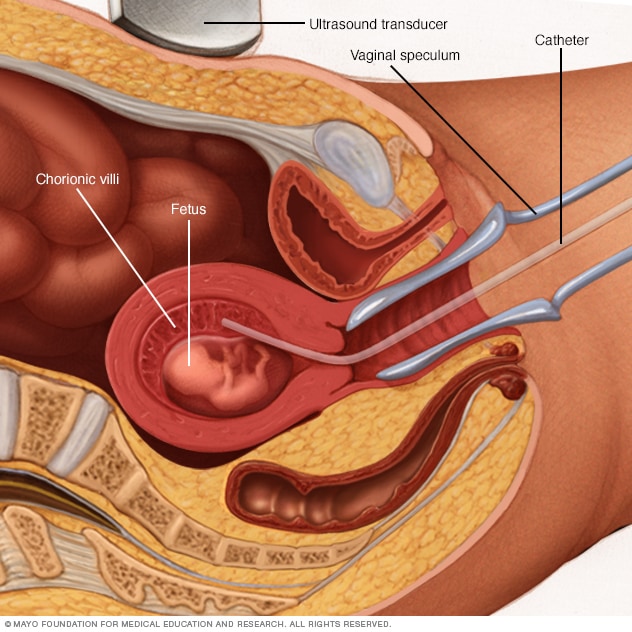
The chorionic villus sample can be taken either through the cervix (transcervical CVS procedure) or the abdominal wall (transabdominal CVS procedure ).
You might be interested in reading 9 Procedures You Might Want To Reject During Pregnancy.
Who is offered CVS testing?
CVS is a prenatal test generally offered to women who are at higher risk of having a baby with Down syndrome and other chromosomal abnormalities.
This group includes:
- Pregnant women who have an increased nuchal translucency (NT) noted at the 12-14 week ultrasound
- Mothers who will be 37 years or older at the time of birth
- Mothers who have had a previous pregnancy with a Down syndrome baby.
The test is available to anyone who wishes to have it, especially those with a family history of birth defects.
A CVS can’t test for spina bifida, but another scan can be performed at 18 weeks, when many potential physical abnormalities of a baby can be detected.
When is the chorionic villus sampling done?
The optimal time frame to have the chorionic villus diagnostic test is between 11 and 14 weeks of pregnancy.
In certain situations, it can be done later, but it’s not usually done before 10 weeks of pregnancy.
The CVS isn’t done earlier in pregnancy because of the slightly increased risk of miscarriage. There have also been rare cases of defects in a baby’s fingers or toes when CVS is done before 9 weeks.
Chorionic villus sampling risks
When deciding whether or not to have a CVS, you should be aware there is a very small risk of miscarriage – around 1%.
This is related to the small risk of infection which can occur as a result of having the procedure.
A uterine infection (chorioamnionitis) is one of the possible reasons for miscarriage after either CVS or amniocentesis. This infection occurs in the fluid around the fetus and can infect the baby, causing miscarriage.
Additional possible complications of the genetic disorder test include:
- Failure of the specimen to grow sufficiently in the laboratory
- Uncertain laboratory results.
These complications are very uncommon. If they occur, you still have the option of an amniocentesis test, which is done later, at 17-19 weeks.
You might like to read Chorionic Villus Sampling and Amniocentesis: Recommendations for Prenatal Counseling for more information.
How do I prepare for CVS testing?
Health care providers will take a full medical and family history, and check whether you have a medical condition that will affect the procedure.
They will also discuss the procedure, and you will be asked to sign a consent form.
A moderately full bladder is helpful to the sonographer. When the bladder is full, it gives the sonographer a better view of the baby.
This is related to the way in which sound waves move through the body. The sound waves meet different mediums like air or fluid differently.
The full bladder enhances the movement of the sound waves inside the abdomen, making the view of the required structures clearer.
Before the biopsy, a scan is performed to see whether there is more than one baby in the womb and to check the baby’s wellbeing. This can usually be confirmed with a normal fetus heart rate.
It’s important to know what your blood group is before having the test.
Ask your midwife or health care provider to access this information or bring along your blood group card at the time of the CVS.
If your blood group is Rh negative, you might require an injection after the test. This is done if the mother’s blood type is different from the baby’s.
The crossing of the blood types causes the mother to produce antibodies that can be harmful to the baby. This is because the antibodies attack the baby’s red blood cells.
You might be interested in reading Rhesus Factor And Pregnancy: A Must Read If You Have Rh- Blood.
How is the CVS done?
Once you’re comfortable on the exam table, if you’re having a transabdominal procedure, the skin of the lower abdominal wall is cleansed with an antiseptic solution.
The skin and underlying tissues are injected with a local anesthetic. The discomfort felt during the injection of the local anesthetic is similar to that felt when blood is drawn from the forearm.
With ultrasound guidance, a thin tube needle is then directed into the placenta and a biopsy of placenta CVS tissue is taken (chorionic villi cells).
Sometimes a dragging sensation is felt in the pelvis or in the legs during the procedure. This is commonly experienced with CVS tests.
Occasionally, the position of the placenta on the uterine wall can make the transabdominal procedure too difficult as the thin tube can’t reach the tissue.
It might be recommended to have the CVS done via the cervix, this is called a transcervical procedure.
The transcervical procedure involves the use of a catheter, inserted through the cervix into the placenta to obtain the tissue sample.
Is a CVS test painful?
The CVS test for genetic defects might be a little uncomfortable but shouldn’t be painful.
The transcervical CVS is similar to the cervical screening test. An injection of local anesthetic will be given prior to the transabdominal CVS. The anesthetic should make the area feel numb and might feel mildly tender afterward.
If you have persistent pain that doesn’t respond to simple analgesia following your procedure, be sure to contact your health care provider.
What should I do after the chorionic villus sampling test?
It is recommended you rest up for the day and avoid strenuous activity, such as heavy lifting.
After the test, most pregnant women experience short-lived mild cramping, like menstrual cramps or leg pains, which last for a few hours.
This is most likely to occur after the local anesthetic wears off, within the first half-hour after the test.
Some patients experience slight vaginal spotting after the screening test; this is not unusual.
Warning signs of miscarriage include strong regular period-like pains with fresh red vaginal bleeding. Immediately contact your midwife or health care provider should this occur.
The time when miscarriage is most likely to occur is the first few days to one week after the test.
We recommend you read these articles for more information:
Signs Of Miscarriage | 5 Signs To Know
Early Miscarriage – Signs, Symptoms and What To Expect
What happens after the CVS biopsy has been taken?
The chorionic villi specimen is sent to the laboratory and processed. The small tissue sample is placed in a culture medium and then into an incubator for several days.
When there is a sufficient number of dividing cells, the specimen is removed from the incubator and the placental cells are split open with an enzyme.
The individual chromosomes are counted and carefully analyzed for major and more subtle genetic abnormalities or chromosomal conditions.
Chorionic villus sampling test results | time
The entire genetic condition information test takes around two to three weeks to process.
If the test is looking at rarer genetic conditions, it might take longer. If the screening test is checking for a specific chromosomal disorder, it can take up to four weeks.
Although cases are rare, if you find out that your unborn baby has tested positive for a chromosomal abnormality, your care provider will refer you to a genetic counselor for a whole consultation. This will help you understand the chromosomal disorder and the options available to you.
We think they’re the best on the internet!
Click to get the FREE weekly updates our fans are RAVING about.
Can chorionic villus sampling detect open neural tube defects?
The CVS can’t test for neural tube birth defects. In around 99% of cases, the chorionic villus sampling is accurate for detecting chromosomal abnormality.
The chorionic villus sampling (CVS) also reveals the sex of the baby, so it can identify genetic disease linked to one sex. This might be a chromosomal condition, such as certain types of muscular dystrophy that occur most often in males.
Chorionic villus sampling vs amniocentesis
A CVS has a slightly higher risk of miscarriage than amniocentesis because it’s done in early pregnancy (first trimester) rather than the second trimester.
Because your pregnancy will be at a slightly more advanced stage before you have results from amniocentesis, however, you will have less time to consider your options than with a CVS.
An amniocentesis provides the same genetic information as chorionic villus sampling (CVS) does.
The thin needle is directed into the amniotic fluid, which contains the unborn baby’s cells. This amniotic fluid is extracted and tested for chromosomal defects.
Your health care provider might recommend an amniocentesis if the chorionic villus sampling (CVS) result is inconclusive.
Chorionic villus sampling can’t detect certain birth defects, such as neural tube defects. If neural tube defects are a concern, an ultrasound or genetic amniocentesis might be recommended instead.
You might be interested in reading Amniocentesis – Definition, Risks And What To Expect.